

Cleats
-
-20%
 out of stockSpecial Price $79.99 Regular Price $99.99
Out of stock
Boat Cleats
Whether you are tying off at a dock, setting an anchor line off the bow, or running a tow line to another boat, the right boat cleat handles the load without pulling free or chewing the line. At Marine Depot Direct, you will find boat cleats in standard, arch, herreshoff, folding, pull-up, stud-mount, mushroom, and torpedo styles, in 316 stainless, 304 stainless, aluminum, and galvanized construction. Marine cleats are stocked in sizes from approximately 3 inches to 12 inches to match line diameter and expected load.
Cleat Types by Profile
Boat cleats fall into several profile and shape categories. The right style depends on deck space, expected load, and whether you need a low-profile cleat that folds flat when not in use.
Standard Horn Cleats
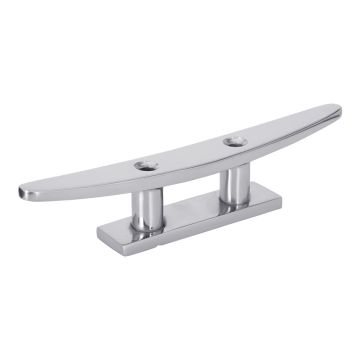
The classic cleat boat profile, with two arms running parallel to the deck. Standard cleats accept any line wrap pattern and are stocked in 316 stainless construction across multiple sizes. Stud-mount versions add threaded studs welded to the underside that through-bolt to a backing plate for high-load applications.
- Open-base horns with topside fasteners
- Closed-base horns with concealed fasteners
- Stud-mount horns through-bolted to a backing plate below deck
Pop-Up and Pull-Up Cleats
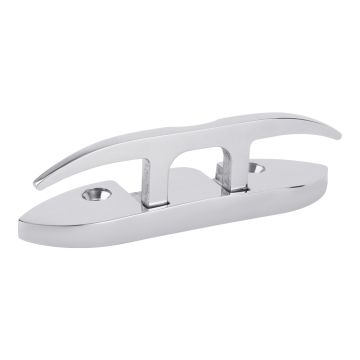
Fold flat into a low-profile housing when not in use to eliminate trip hazards on walkways, foredecks, and swim platforms. The flat profile clears most deck shoes and reduces line snags on foredecks.
- Spring-loaded pull-up mechanism for one-hand deployment
- Positive lock that engages under load
- Stainless construction throughout the moving parts
Weldable and Specialty Cleats
Beyond standard horn profiles, several specialty cleat shapes serve specific applications. Arch cleats give a higher line wrap clearance, herreshoff cleats offer a classic low profile, and torpedo cleats handle limited deck space.
Material Selection
For marine grade stainless steel boat cleats, 316 grade is the working standard. The molybdenum content resists chloride pitting in saltwater service, and investment-cast 316 produces a one-piece structure for primary mooring loads.
- 316 stainless: saltwater service, primary mooring loads
- 304 stainless: freshwater applications and trailered boats
- Cast brass: acceptable for freshwater, tarnishes in salt
- Cast aluminum (356-T6 alloy): mid-cost option, lighter than stainless
- Galvanized iron: sheds rust as the zinc layer wears
- Injection-molded nylon: low-load applications such as kayaks and small dinghies
Stainless boat cleats outlast every other common material in salt water by a wide margin.
Mounting Style and Backing
Cleat mounting styles match the access available below deck and the load you expect at peak.
- Open-base cleats install with topside fasteners and do not require below-deck access. They work for retrofit installations on cored decks and finished interiors.
- Closed-base cleats hide the fasteners under the cleat body, giving a cleaner finish and protecting the fastener heads from line wear.
- Stud-mount cleats use threaded studs welded to the underside, through-bolting to a backing plate. This is the strongest configuration and the standard for high-load applications such as bow and stern tie-downs on larger boats.
A backing plate distributes load across a wider area of deck, reducing the risk of pulling fasteners through under peak loads.
Sizing by Line Diameter
Cleat size is set by the line diameter you will be making fast. As a working rule, allow one inch of cleat length per 1/16 inch of line diameter:
- 3/8 inch line: 6 inch cleat
- 1/2 inch line: 8 inch cleat
- 5/8 inch line: 10 inch cleat
- 3/4 inch line: 12 inch cleat
Smaller cleats cause the line to slip under load. Larger cleats waste deck space and do not hold the wrap securely. Published minimum breaking load values let you match the cleat to expected peak loads from wind, current, and tide.
If you are unsure which boat cleat option to choose, contact us and our team can help with general product guidance, mounting style questions, and selection support.
Why Buy from Marine Depot Direct?
We stock cleats for boats in sizes from 3 inches to 12 inches across standard, arch, herreshoff, folding, pull-up, stud-mount, and torpedo styles. Our team can confirm line diameter, expected load, and deck thickness against your cleat selection before you order, which prevents the common mistake of an undersized cleat or insufficient backing plate.
Frequently Asked Questions About Boat Cleats
What is the difference between 316 and 304 stainless on boat cleats?
316 contains molybdenum that resists chloride pitting in saltwater. 304 lacks that addition and will eventually develop surface rust at fastener holes and stress points in marine service. For dock lines and mooring loads in salt water, 316 is worth the price difference; 304 is acceptable for freshwater applications.
How do I size a cleat for my dock line?
As a working rule, allow one inch of cleat length per 1/16 inch of line diameter. A 3/8 inch line wants a 6 inch cleat; a 1/2 inch line wants an 8 inch cleat; a 5/8 inch line wants a 10 inch cleat. Undersized cleats cause the wrap to slip under load.
Do folding and pull-up cleats hold the same load as standard horn cleats?
High-quality 316 stainless folding and pull-up cleats are designed to handle standard mooring and docking loads for their rated size. However, because they contain mechanical parts and pivot points, they are typically recommended for recreational docking and temporary tie-offs. For permanent mooring in high-surge areas or heavy-duty commercial applications, a solid, fixed-base Herreshoff or standard horn cleat is generally preferred for its one-piece structural integrity. Always ensure any cleat is through-bolted with a proper backing plate to maximize its load capacity.
Can I install a cleat without access to the underside of the deck?
Open-base cleats install with topside fasteners and do not require below-deck access. They work well for retrofit installations on cored decks and finished interiors. Closed-base and stud-mount cleats need a backing plate below the deck and through-bolted fasteners, which require interior access during installation.