


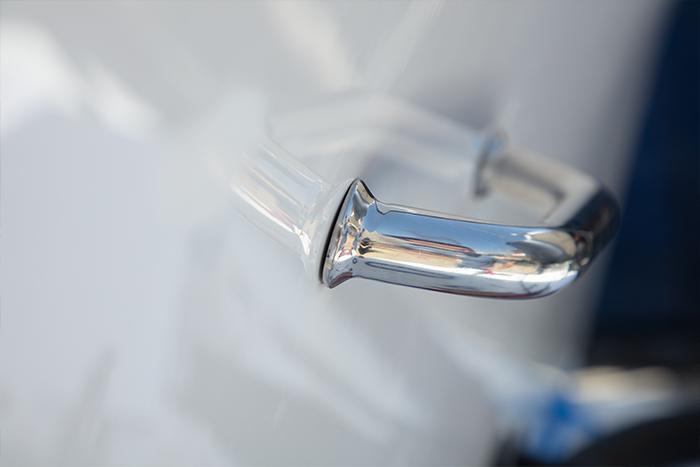
Grab rails and other supports on boats are often overlooked and probably not much of an active thought in most boaters’ minds. However, when you’re in choppy water or trying to reboard your boat after jumping in, the additional support is essential. Driving and controlling a boat can sometimes be quite challenging, especially in rough conditions. However, if you happen to have a handrail nearby, you can clutch on for added support and boat with confidence. Handrails can easily be disregarded, but these hardware components help you enjoy the experience without much (if any) worry about avoidable accidents. Boat grab bars also keep you from damaging other components on your boat, as you will not hold them to balance.
In this article, we discuss grab rail placement, sizes and mounting types available in the marine industry today.
Boat Grab Bars Placement
When it comes to the placement of boat grab bars, you need to install them in several areas on your boat. However, it is important to understand that the areas your passengers use the most are the ones you should think about first. Here are some boat rail placements that you should probably consider.
Helm
If your boat has a helm, then you need to install a handrail near it. You can find several rails in the market made for the top of the boat. They are designed for welding to the upright position so that the person driving the boat can tightly grab it.
If your boat doesn’t have a top, then you need to think about the console rail. You can install it in a way that it arches over the helm, allowing your co-pilot to hold it tightly.
Helm Seats
You should also install boat grab handles near the helm seats. This helps the sitting person tightly hold on if the boat runs too fast to keep their balance. However, most of the time, this area lacks a handrail, which forces the crewmember to grip fishing rods or whatever else is close by. Of course, it is not safe and may cause an accident.
Bow
Many modern center console boats come with high-profile bow rails. However, some companies don’t offer any handrails. If you have bought a fishing boat or any other type of boat that doesn't have a bow rail, you should consider installing one. This way, anyone standing at this point can hold on if needed, instead of holding the closest thing that comes in their hands, leading to costly repairs.
Gunwale
Another important placement for a boat grab handle is the gunwale. This is one of the more common places where people usually stand. Some boat captains also ask passengers to board through the gunwale side. It also allows the staff, captain, or passengers to move easily about the boat while the boat is moving fast.
Seats
If there are seats on your boat for passengers or guests, then they’ll need something to grab when the waters are in harsh conditions. You never know when the captain might start to drive the boat fast, causing someone to fall from their sitting position. Hence, it might be a good idea to install handrails right behind the seats.
What Sizes are Available for Grab Bars?
Marine grab rails can be found in almost any size you need. And if the size you need isn’t available, you can contact railmakers.com to inquire about creating custom grab rails for your unique application. Ultimately, you’ll likely opt for a handrail that suits the type and shape of your boat, and maybe even matches your other hardware (all stainless). It all comes down to measurements and preference.
The most common and popular marine hardware materials are aluminum and stainless steel. Both of these boat grab bars can be great options depending on your specific needs. They are typically available in 7/8” – 1-1/4” diameter, which helps to hold on tightly, no matter how big or small your passenger’s hands are.
Apart from this, both of these materials are usually available up to 72 inches in length. You can choose the length that will properly fit based on your required area.
Mounting Types
Boat handrails are usually top-mounted or stud-mounted depending on the location and personal preference with aesthetic.
Top Mounted
This option has a metal flange on either side of the railing with 3 or 4 holes to screw in fasteners and secure it to the hull. Visually, it is a little more exposed metal and looks unfinished compared to the stud mount option.
Stud Mounted
This mounting option requires a little more work for installation as you will need access to the underneath side of the hull, but offers a much more finished and sleeker look once it tightly fastened. Most boaters will prefer this option as it has more of a luxury appeal to it.
Boat Rail Fittings
You can use different fittings to create your own grab rails if you already have the stainless tubing. Here are some fittings that help you connect different parts of the handrails.
Tees
These are the most common fittings because they are more versatile than others. They are much similar to the plumbing tees and offer you three-way connections so that you can connect tubes coming at three different sides.
Rail Bases
These help you connect the handrails to the deck of your boat. They are available in many angles, starting from 30° to 90°. Moreover, they come with either rectangular or round bases, and serve as the foundation of your grab rail.
Bow Forms
Bow forms are simple fixtures that help you connect two tubes at approximately 110 or 125-degree angles.
Universal Tees
These tees look similar to the traditional ones, but the third leg intersects at an angle of 60 degrees.
Elbows
Elbows have two openings to connect two rods at boat sides, offering you an elbow-like shape. It helps you connect the rod at 90° intersections.
Bottom Line
In conclusion, now you might have a better understanding of what type of grab bar will be suitable for your boat and different areas you might want to consider adding new ones. Be sure to choose high quality stainless steel grab rails to install on your boat for the safety and security of yourself and others.
Sources
https://www.sportfishingmag.com/handrails-improve-safety-at-sea/
https://www.westmarine.com/WestAdvisor/Selecting-Rail-Fittings
https://www.boatingmag.com/what-to-look-for-in-grab-handles/